
Emancipation of the dissonance

To even the trained ear, it can be easy to dismiss Arnold Schoenberg’s (1874-1951) mature works as impenetrable and gratuitous. Take a listen to 15 seconds of this and come back.
There’s definitely something there, but it’s written in a language neither of us understand and it’s unclear if it’s the musical translation of a great work of literature or a grocery list.
So who is this dude? Where did he come from? And how did he manage to get people to take 12-tone music so seriously?
Schoenberg did not attend conservatory and was largely self-taught save counterpoint lessons he took with Alexander von Zemlinsky (1871-1942). Zemlinsky was well-established and managed to get Schoenberg and his work in front of composers such as Richard Strauss (1864-1949) and Gustav Mahler (1860-1911), both of whom recognized Schoenberg’s brilliance. But the pieces these composers were introduced to were composed in the familiar, tonal style. Take, for example, Verklärte Nacht, Op. 4 (1899). Written for string sextet, the piece is highly chromatic and travels between being lush and big and fragile and small. Schoenberg clearly understood the project of Romanticism. Brahms, eat your heart out!
But Schoenberg felt strongly that he was the heir to the Germanic classical tradition, and to keep the tradition alive, he needed to innovate within it. And so he fixated on the idea of dissonance and how it could serve as the basis for a set of organizing principles in contrast to traditional harmony.
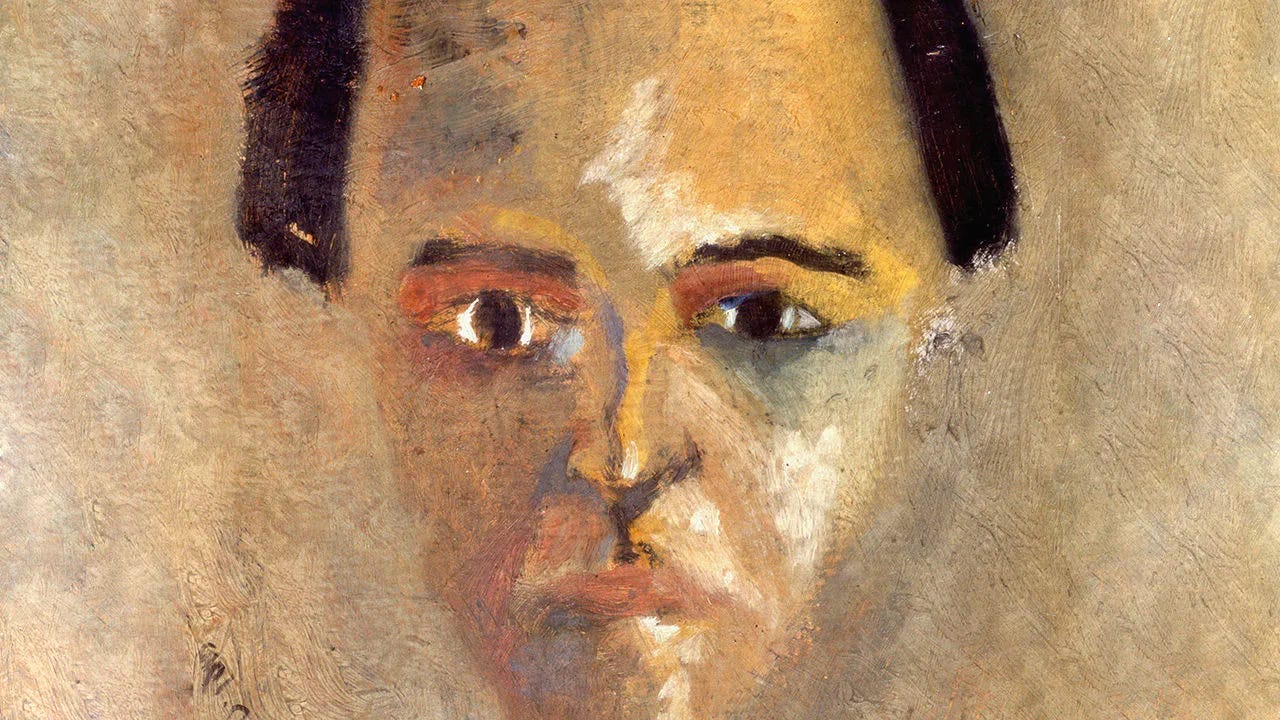
Schoenberg thought about the push into atonality as the inevitable extension of the traditional harmonic system. And, it sort of makes sense… in the middle ages, the major third, a third we all know and love, was considered dissonant (mostly because those folks were obsessed with octaves, fifths, and fourths, and when you stack those to get to a major third, you get a pretty gnarly one). As time went on, we found ways to embrace the major third, and variations on the dominant key (the fifth) became the dissonance we traveled to and then safely returned home from. As we got better and better at teeing up crunchy dissonances and even lingering there for longer, we learned to “be in” the space of the dissonance. Think about jazz… many many jazz standards end on a dissonant chord or note. And we love it! That doesn’t feel odd to us.
So Schoenberg was saying “we are constantly learning to “be in” more and more dissonance… Now is the time to put roots down in the suburb next door and learn how to make compelling music there.
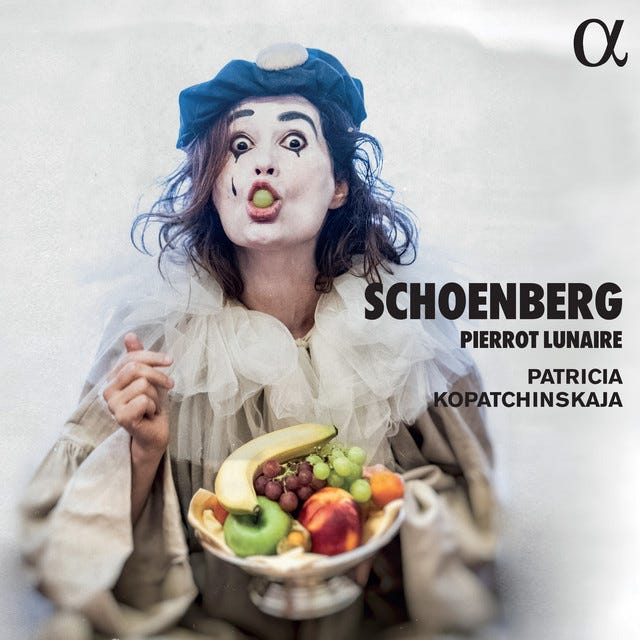
By the time 1912 rolls around, he has written Pierrot lunaire, Op. 21 (1912). Pierrot lunaire, or “Three times Seven Poems from Albert Giraud’s ‘Pierrot lunaire’” is scored for voice and a quintet of instruments and introduces the Sprechstimme technique where the vocalist mashes together speaking and singing (it’s often very eerie…). The piece is atonal (in that there’s no “home” key), but does not quite deploy the strict 12-tone technique Schoenberg would later concretize.
An audience-goer sums up the premier pretty succinctly:
“When she appeared in a Pierrot costume, her painted, frightened face framed by a ruff, her aging ankles in white stockings, she was greeted by an ominous murmur from the audience. One could not help admiring her courage, as she went on from poem to poem, disregarding the hissing, booing and insulting invective shouted at her and Schoenberg. There were also fanatical ovations from the young generation, but the majority were outraged. A well-known virtuoso, his face purple with rage, shouted: “Shoot him. Shoot him,” meaning Schoenberg, not the poor, undaunted Pierrot.”
So if it’s not 12-tone, what is it? It’s considered “free atonality.” There is no “home” key. Schoenberg knew he was onto something, but he hadn’t quite landed the plane. In 1926, he published “Opinion or Insight?” in which he built out the idea of emancipating dissonance and suggested more organizing principles for composers. Much later, in 1941 he published “Composition in Twelve Tones” where he presented his fully-formed thinking on the topic: The composer should give equal emphasis to each of the twelve tones while still producing a satisfyingly sophisticated composition.
Schoenberg was at the center of what was known as the Second Viennese School which is where all the music you’ve ever heard and thought “wow, that’s ... that’s not really nice to listen to” came from. Other members of the school included Alban Berg (1885-1935) and Anton Webern (1883-1945). The First Viennese School comprised Haydn, Mozart, and Beethoven, and they likely all knew one another, but they weren’t like… buddy-buddy like the 2VS guys were (VS2? V2S?). (Nor did they call themselves that.)
Finished in 1928, Schoenberg’s Variations for Orchestra Op. 31 (1928) is, in fact, a proper 12-tone piece. Schoenberg introduces the 12-tone row and then inverts it, presents it in retrograde, inverts the retrograde… you know, just has some fun with it! If you listen carefully you can hear the BACH sequence (Bb A C B natural). I don’t think he snuck the D S C H (Shostakovich) sequence in there but that’s probably only because Shostakovich was 22 and hadn’t done it himself yet.
Schoenberg’s death is, I hate to say it, numerical …? I guess? He suffered from triskaidekaphobia which absolutely should not be a real thing but it is and it’s the fear of the number 13. He obviously was living in fear of dying in 1952 (or 1965) but then an astrologer called him and pointed out that at the age of 76… he should be pretty fearful just about every day (7+6 = 13).
He made it literally 15 minutes to the stroke of midnight of his birthday. The stuff of legends.
I’ll follow up with a part-2 about Webern soon (because he loved music that makes you want to scream AND ALSO died in a weird way). Ciao for now.
As usual, this has been extremely lightly researched, please don’t fact check anything. I’ve made a Spotify playlist of the music cited above! Check it out.