
Liminally speaking

Mary Shelly’s Frankenstein (1818) is bonkers and was groundbreaking for many reasons. Shelly writes a story about creation that pushes women to the periphery. She blends gothic horror with science fiction. And she deploys a fairly novel structural device wherein she nests the stories within one another. She teases you and builds suspense by inviting you into a fairly complicated game of telephone. You don’t get to learn about Victor’s monster through firsthand observation. You hear about it as Victor relays it to Walton as it was told to him. What’s the truth? Is there one truth? 😵💫
Shelly lived and worked as Europe slipped from the Enlightenment into Romanticism. She may have been listening to Beethoven’s seventh (1812) or Rossini’s Barber of Seville (1816). Both popular, Romantic-era pieces played with structure in different ways, but both are also immediately recognizable as “romantic symphony” and “opera buffa” or comic opera. Neither of these pieces are animated by structural choices in quite the same way Frankenstein is (see what I did there?).
There’s a strong high school essay argument to be made that Frankenstein represented a turning point in English literature, elevating structure as a dramatic device. I think it took classical music a bit to catch up, but it eventually made it there. There are lots of obvious examples to look at, but I want to share something more subtle and unassuming.
Jean Sibelius (1865-1957) was the composer who defined the Finnish sound. Working during the fraught period of Finnish Russification, Sibelius forges a national sound not just through the use of folk tunes, but through clever harmonic, timbric (I made that word up), and structural decisions that reflect the cold and expansive Finnish tundra. His work bridges Romanticism and early Modernism. One of the cooler liminal spaces, IMO.
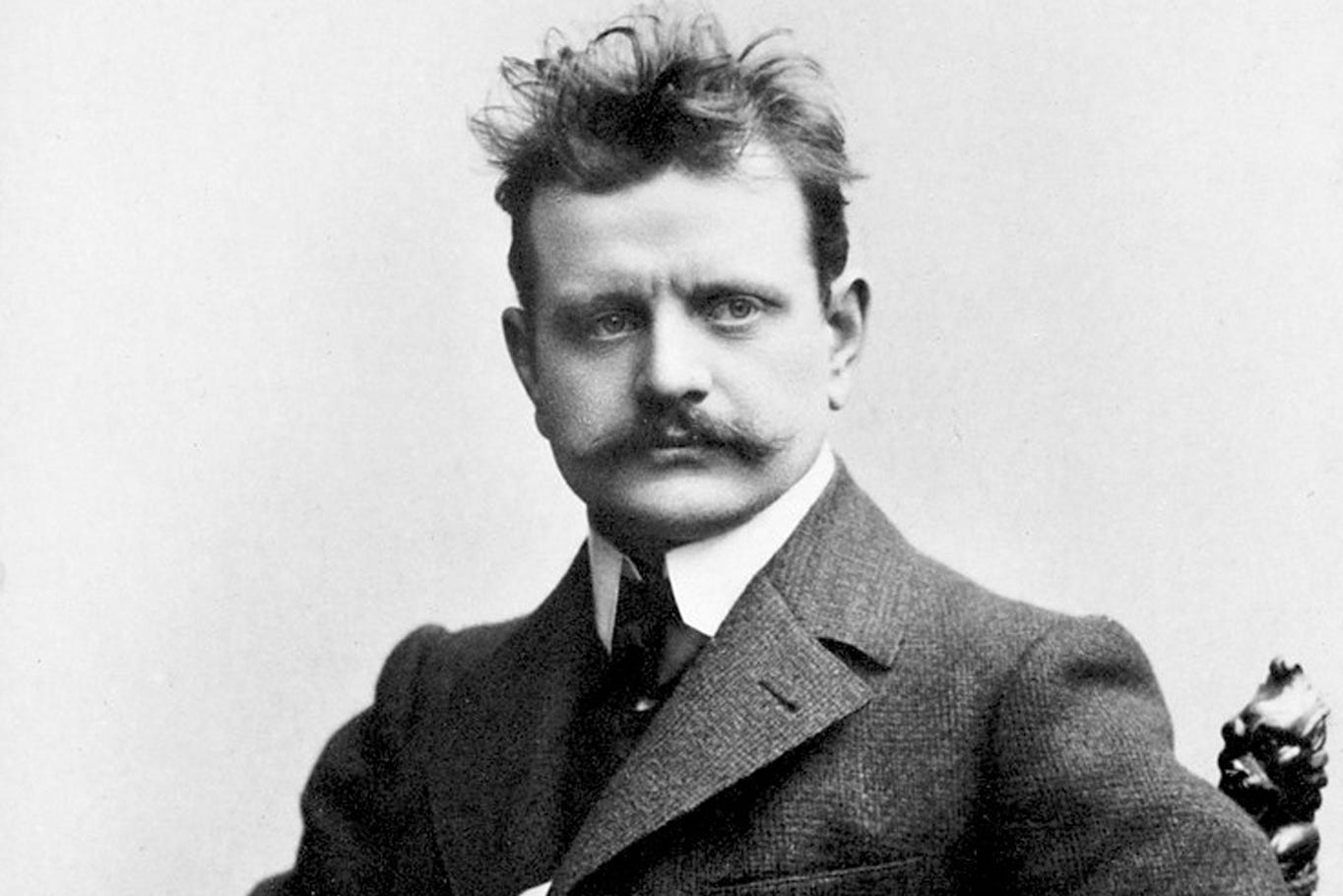
I remember first hearing/playing Sibelius’ second symphony (1902) and being hypnotized and confused. There is no straightforward, I-can-point-to-it-therefore-it-exists melody in the first movement for roughly four entire minutes. And yet it’s a memorable opening. That’s crazy. For comparison, the Beethoven includes a lengthy introduction, and we get to the first theme at 3:30, but it’s totally unrelated to the introductory material.
Sibelius rejects the idea that a primary theme or melody needs to be introduced at the top of the movement only to return triumphantly at the end, and instead grows one (or two) for us in a sort of petri dish. As I listen, I can picture myself in a low-flying plan dipping in and out of a forest, rounding a lake. It’s cold out but I’ve got a good coat. Sibelius had a gift for using the thermostat for dramatic effect.
I think the embrace of melodic fragments that eventually gel together sets up a really satisfying, but delayed, payoff. And I think Frankenstein plays out in a similar way. Both works are born of smaller pieces that ask you to “hang on” just a little while longer.
Enjoy.
As usual, this has been extremely lightly researched, please don’t fact check anything. I’ve made a Spotify playlist of the music cited above! Check it out.