
Use your imagination

For Marcel Proust, music was not merely a background accompaniment to life; it was the key to unlocking the “involuntary memory” that defines his masterpiece. À la recherche du temps perdu (In Search of Lost Time) is an upsettingly long story about a kid who can’t go to bed without a goodnight kiss and needs to unpack every stinking thing that happens to him so thoroughly your head will spin. One of the major ideas the book stands on is that physical sensations, including sounds, can trigger involuntary memories.
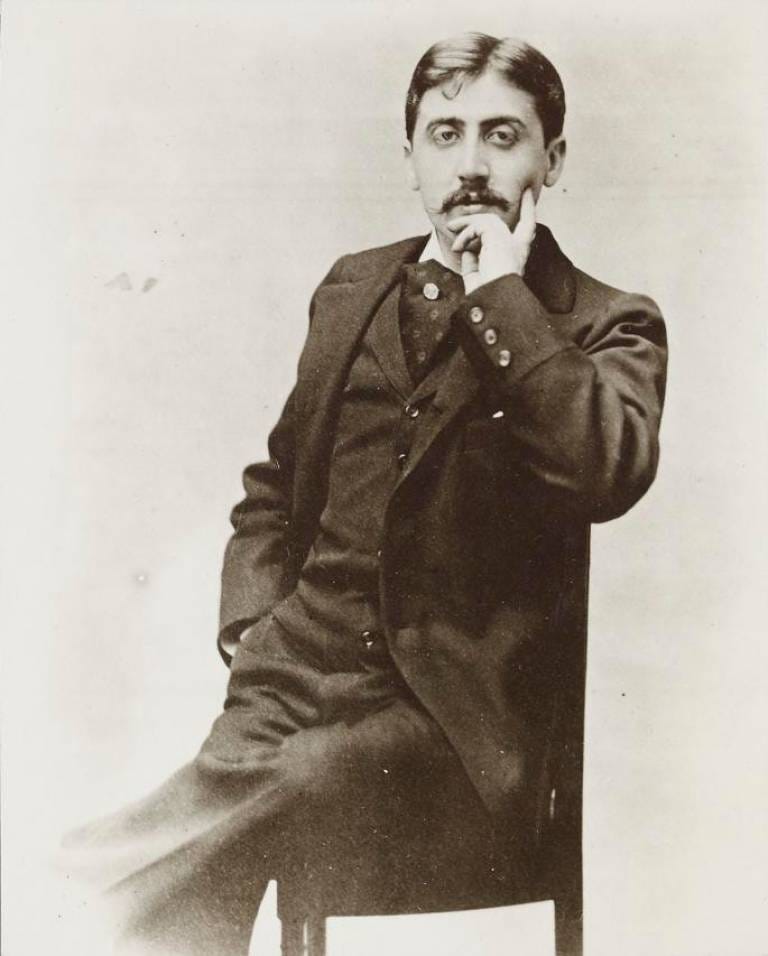
Spanning seven volumes and more than 3,000 pages, In Search of Lost Time is one of the mega beasts of Western literature. It is feared for its labyrinthine sentences and painstaking exploration of how physical sensations, like the mouthfeel of a madeleine (which should not be spelled like that) or the faint sound of a violin melody, can trigger a flood of forgotten memories.
While the madeleine (so hard to get that second “e” right) is the novel’s most famous trigger (for Marcel, the narrator), the “Vinteuil Sonata” serves as its emotional engine (for both Marcel and family friend Mr Swann). In the book, Mr Swann, falls in love with a woman named Odette. Their romance becomes inextricably linked to a “little phrase” of music from a sonata by a fictional composer named Vinteuil (18??-18??). Whenever Swann hears this melody, he is overcome by the intensity of his love for the idea of Odette and the pain of its unavoidable decay (in reality, she’s kind of a loser) (or, I’ve only read the only volume so I guess I can’t say that for certain).
Which real-world composition inspired this fictional sonata has been the topic of heated Reddit threads for decades. Proust was no stranger to the Parisian musical salon scene and has left us conflicting clues. In a letter to Jacques de Lacretelle, he confessed that part of the Vinteuil Sonata was a composite: the violin’s tremolo came from Saint-Saëns’s (1835-1921) Violin Sonata in D minor, while other pieces were stolen from Wagner’s (1813-1883) Lohengrin, Franck’s (1822-1890) Violin Sonata, and tunes by Gabriel Fauré. Not great ingredients for a mash-up IMO but no one asked me.
Proust’s crippling asthma often confined him to his soundproofed, cork-lined bedroom (not making that up). To stay connected to the musical world without leaving his bed, he became an early adopter of the Théâtrophone, a terrifying looking thing that allowed subscribers to listen to live opera and concert performances over phone lines.
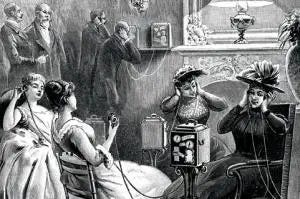
Through this device, Proust listened to Wagner’s The Flying Dutchman and Debussy’s (1862-1918) Pelléas et Mélisande. He was particularly obsessed with Wagner, once remarking that the use of “leitmotifs” (recurring musical themes associated with specific characters or ideas) helped him structure the recurring themes in his own writing.
When the Théâtrophone wasn’t enough, Proust paid out the nose to bring the music directly to his bedside. In 1916, he summoned the Poulet Quartet to his apartment in the middle of the night. He had them perform Franck’s String Quartet and Beethoven’s late quartets while he lay in the dark, taking notes on the sensory experience of the performance.
Proust’s long-time partner, Reynaldo Hahn, was a composer himself. Hahn introduced Proust to musical theory, enabling him to describe melodies credibly. For Proust, music was the highest form of art because it communicated emotions that words, no matter how beautiful, could never fully capture. But as they say… those who can’t compose, write a lot.
As usual, this has been extremely lightly researched, please don’t fact check anything. I’ve made a Spotify playlist of the music cited above! Check it out.
I would also like to sleep in a soundproofed, cork walled bedroom. This is a beautiful playlist, will be my snowstorm background music !